
VeloxChem at WATOC 2025
VeloxChem Team, PDC & KTH
At this year’s World Congress of Theoretical Chemists (WATOC) 2025, VeloxChem was proud to sponsor the event and showcase the latest developments. The VeloxChem booth featured live demonstrations where visitors could try out VeloxChem using Jupyter Notebooks, focusing on how the Python interface streamlines the preparation and execution of computational chemistry workflows.
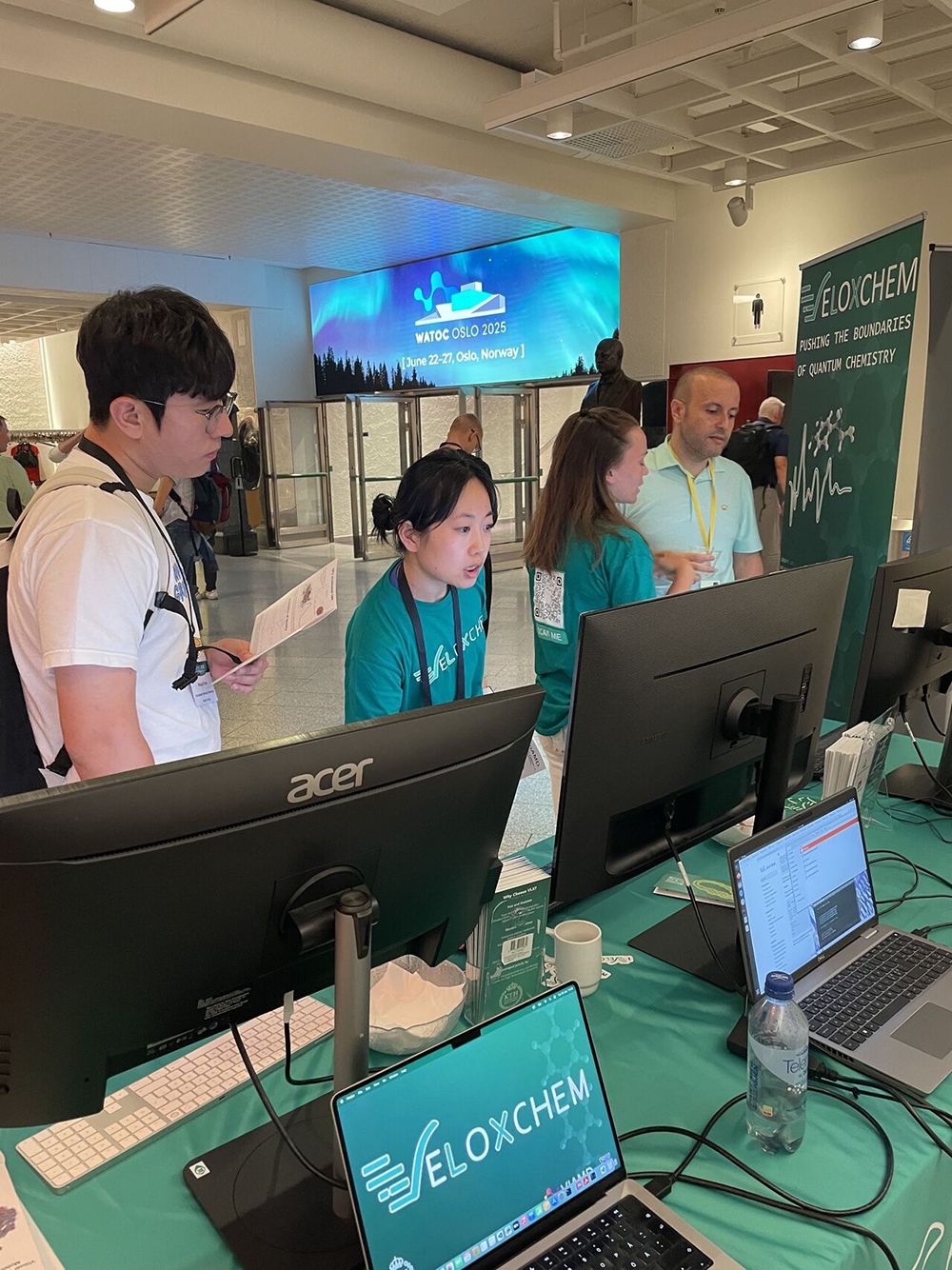
During these sessions, we highlighted recent advances in VeloxChem, particularly its new GPU support, which enables users to handle much larger molecular systems than previously. We discussed real-world examples, including recent research on G-quadruplex DNA, which demonstrates how VeloxChem performs on modern high-performance computing (HPC) and GPU infrastructures [1].
We also introduced participants to both the comprehensive documentation on the VeloxChem website [2] and a collection of Jupyter Notebooks that are available in a GitHub repository[3]. These resources are designed to help users get started quickly and make the most of the software’s capabilities. As an extra incentive, we invited attendees to try installing VeloxChem themselves – those who did so at our booth received a VeloxChem t-shirt as a thank you for engaging with our open-source community.
In addition, visitors also tried out recent features in VIAMD [4], such as the ability to read VeloxChem output files, plot molecular orbitals, and interactively analyse spectra. These improvements make it easier for users to visualize and interpret their results directly within the software, which supports both research and teaching applications.
Many conference participants were impressed by the performance of our tools on large systems and were pleasantly surprised to learn that both VeloxChem and VIAMD are open source and free. Several researchers mentioned that having access to such powerful, freely available software significantly lowers barriers for newcomers entering the field. Others appreciated the intuitive workflows and the way the tools integrate visualization and analysis, making complex data more accessible.
Overall, the event was a valuable opportunity to connect with the broader computational chemistry community, receive constructive feedback, and discuss future directions for both VeloxChem and VIAMD. The positive reception and interest from attendees have motivated us to continue developing these tools in collaboration with users worldwide.
References
- X. Li, M. Linares, P. Norman, “VeloxChem: GPU-accelerated Fock matrix construction enabling complex polarization propagator simulations of circular dichroism spectra of G-quadruplexes”. J. Phys. Chem. A (2025) 129(2), 633–642. doi.org/10.1021/acs.jpca.4c07510
- veloxchem.org
- github.com/VeloxChem/vlx-notebook
- github.com/scanberg/viamd